From Months to Hours: How I Revived Legacy Code with an AI Co-Pilot
A legacy C++ application comprising 150 source files and 76,000 lines of code had remained dormant since 2006, deemed too costly to migrate. In this article, I share how my experiment with AI assistance slashed the estimated migration time by 96%, proving that human-AI collaboration can transform “impossible” legacy debt into a viable path forward.
My New Math of Migration: From 200 to 8 Hours
The most critical takeaway from this experiment is the dramatic collapse of the development timeline. What I initially estimated as a 200-hour manual migration was completed in just 8 hours through a structured collaboration with the AI model Claude. For me, this shift brings modernization much more within reach – especially for less complex systems – reducing the “discouragement barrier” that often holds companies back from updating their critical legacy system. By utilizing AI as an iterative partner, I have fundamentally altered the cost and risk profile of this software migration.
Recruiting my AI Co-Pilot
I shifted the project from a solo rescue mission to a controlled collaboration. My setup was lean: Claude was deployed locally with a command-line interface integrated directly into a separate window in Visual Studio 2026. This allowed for a continuous dialogue where I provided the context – such as the architecture consisting of an executable and two dynamic-link libraries – and the AI provided the roadmap. I remained the final authority, transforming the process from tedious manual searching into a high-level strategic partnership.
The Ghost in the Machine: My Encounter with Legacy Debt
The subject of my migration was a graphical C++ application that had been sat untouched for nearly two decades. Built in 2006 with Microsoft MFC and ODBC, the project consisted of 150 source files, 76,000 lines of code, and 283 object classes. While functional in its era, it had become a “neglected artifact”. Until I used AI to reframe the problem, the sheer scale of the legacy debt made the project economically unjustifiable for me to touch.
Resurrecting the Build and Polishing the Artifact
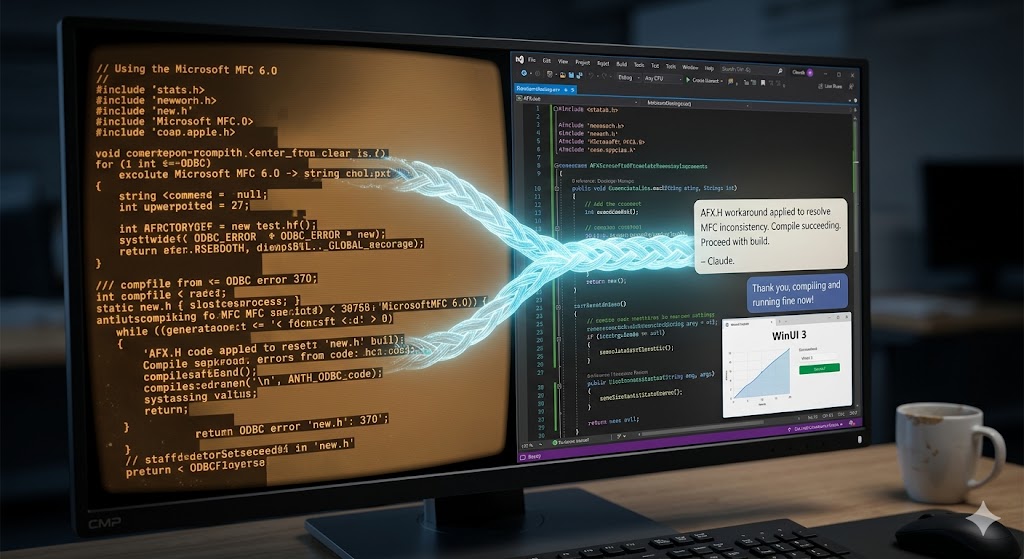
My technical execution focused first on “Resurrecting the Build”. The transition to the latest compiler triggered a flood of mundane errors ranging from outdated header locations to header inclusion order problems, modernization of system header files, and adjustment of preprocessor definitions.
I fed these errors to Claude, which provided targeted surgical fixes. For example, regarding an MFC inconsistency, Claude advised:
“The afx.h file references new.h, which is no longer included in Visual Studio 2026. This appears to be an inconsistency in the MFC headers. The proposed workaround is appropriate until an official correction is issued. Please proceed and report the subsequent build output.”
Once I had the application compiling, I used static analysis to identify quality issues that had existed since 2006. Most corrections were done manually, and a few were directed for the AI to implement directly. The process resembled collaboration rather than automation, with the human operator (me) retaining final authority. This migration has now cleared the path for my next step: a potential transition to the Microsoft WinUI 3framework.
My Key Learnings
External Resources & Inspiration
Links supporting the AI-driven modernization and industry trend:
Contact
This article was issued by Henning Andersen from Capital Market Partners A/S on April 9, 2026. For further inquiries or professional dialogue regarding this case study, please contact Henning Andersen directly via email at ha@cmp.as. Detailed technical migration logs and supporting documentation are available upon request.
Regulatory status checked: 10 August 2026. Regulation (EU) 2025/2075 requires in-scope transactions in transferable securities executed on EU trading venues